Urban Restorative Technical Reference Atlas
Updated in 2026, this Urban Restorative glossary defines 15 verified terms across masonry, millwork, and building systems since 2021.
- Standardized terminology aligns architects, masons, and general contractors on reversible preservation methods.
- Masonry terms distinguish sacrificial lime binders from incompatible high-strength Portland cement.
- Building system entries define non-destructive retrofit components used in early twentieth-century residences.
How to Use This Technical Preservation Glossary
Historic home restoration bridges structural engineering, traditional finish carpentry, and municipal code compliance. This interactive reference atlas standardizes the exact vocabulary used across Urban Restorative project specifications, field inspection checklists, and homeowner dossiers at /about/ and /services/.
Scope of 15 Verified Restoration Terms
Entries are grouped into three core disciplines: Masonry and Envelope, Millwork and Finishes, and Building Systems. Each definition specifies material behavior, era context, and practical application on early twentieth-century Midwest residences.
Natural Hydraulic Lime (NHL)
A calcified limestone binder that sets both by reaction with water and carbonation, offering high vapor permeability and flexibility for pre-1935 brick repointing.
Spalling
The flaking or shearing of fired clay brick faces caused by trapped moisture freezing behind overly hard, impermeable Portland cement mortar joints.
Petrographic Mortar Analysis
Laboratory acid-dissolution and microscopic testing of original mortar samples to determine binder type, lime-to-sand ratio, and aggregate sieve profile.
Tuckpointing
A traditional masonry technique using two contrasting mortar colors to create crisp, narrow joint lines on historic brickwork, distinct from standard repointing.
Lime Parging
A breathable, sacrificial coat of lime-sand plaster troweled over interior rubble limestone or brick foundation walls to shed moisture without trapping vapor.
Quartersawn White Oak
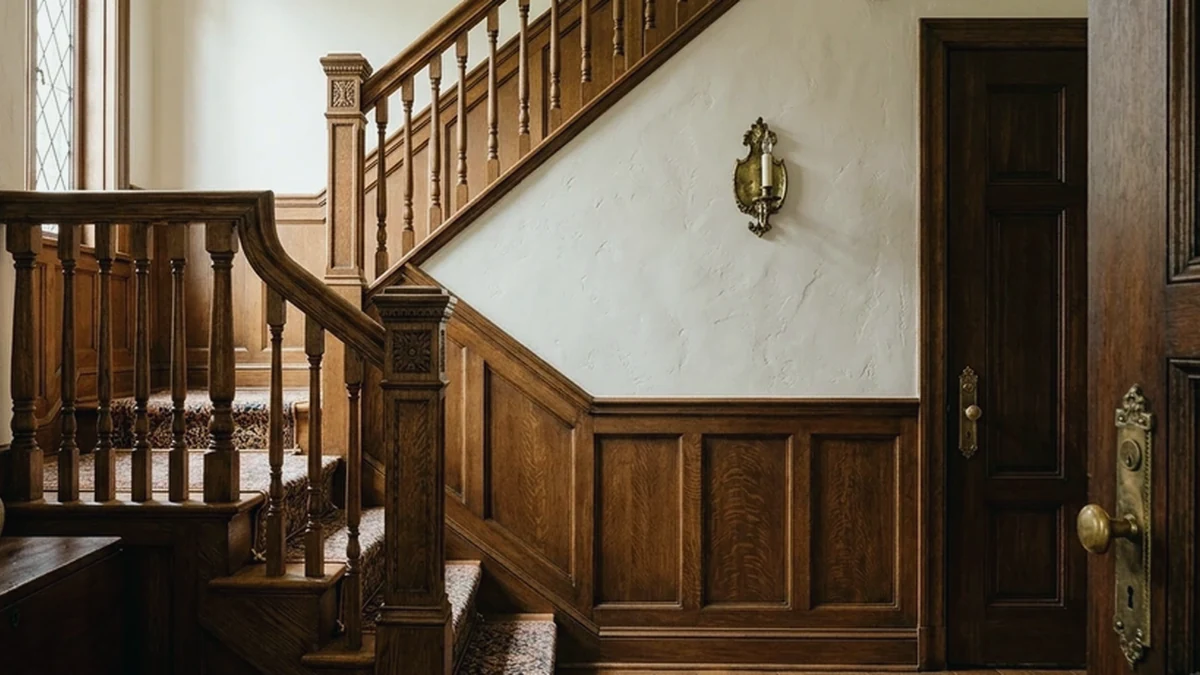
Hardwood lumber milled perpendicular to growth rings to expose distinctive medullary ray flecks and minimize seasonal cupping in Prairie and Craftsman trim.
Plaster Key
The mushroom-shaped protrusion of wet scratch-coat plaster squeezed between wooden lath strips that mechanically anchors the wall surface to framing.
Spring-Bronze Weatherstripping
Thin, folded phosphor-bronze metal strips nailed into wooden window jambs to seal air infiltration around double-hung sashes without altering historic profiles.
Glazing Putty
A linseed oil and whiting compound pressed into wooden window muntins to cushion glass panes and shed rainwater away from sash joints.
Dewaxed Amber Shellac
A natural resin sealer dissolved in alcohol that bonds to historic woodwork, blocks bleed-through, and restores warm early twentieth-century tone.
Small-Duct High-Velocity (SDHV)
An HVAC distribution system using 2-inch flexible insulated supply tubes snaked through existing stud bays to preserve historic plaster ceilings.
Manual J Load Calculation
An ACCA-standardized engineering calculation measuring heat gain and loss by room to size heating and cooling equipment accurately without short-cycling.
Knob-and-Tube Wiring
An ungrounded early twentieth-century electrical system using single cloth-wrapped conductors suspended on porcelain knobs and ceramic wall tubes.
Joist Sistering
Fastening new full-length dimensional lumber or engineered LVL beams directly alongside sagging or notched historic floor joists to restore load capacity.
Combination AFCI/GFCI Breaker
A modern circuit breaker protecting upgraded 200-amp residential panels against both parallel/series electrical arcs and ground-fault shock hazards.
Frequently Asked Questions
How are terms selected for the Urban Restorative Atlas?
Entries reflect recurring materials, failure modes, and specification standards encountered on 1900 to 1940 residential restorations.
Where can I read full installation protocols for these terms?
Detailed workflows are published in our hub pages and feature guides, including /guides/lime-mortar-repointing-1915-brickwork/ and /guides/prairie-tudor-mechanical-retrofits/.
Do these definitions align with National Park Service standards?
Yes, masonry, window, and mechanical retrofit entries follow the Secretary of the Interior Standards for Rehabilitation.
Related Preservation Notes
Historic Masonry, Mortar, and Foundation Preservation Hub
Updated for 2026, this Urban Restorative reference indexes 5 core structural assemblies used across 1915 Prairie and 1930 Tudor
Period Millwork, Plaster, and Interior Finishes Hub
Established in 2021, Urban Restorative catalogs 5 interior finish systems across Omaha Tudor Revival and Prairie residential
Lime Mortar Repointing Protocol for 1915 Historic Brickwork
In 2026 field audits, Urban Restorative confirms that Type O lime mortar prevents freeze-thaw spalling on 1915 Omaha clay brick