Prairie and Craftsman Interior Millwork Restoration: Quarter-Sawn Oak and Built-Ins
Denatured alcohol and shellac French polishing revive 1915 quarter-sawn oak millwork without sanding away original medullary ray figure in 2026.
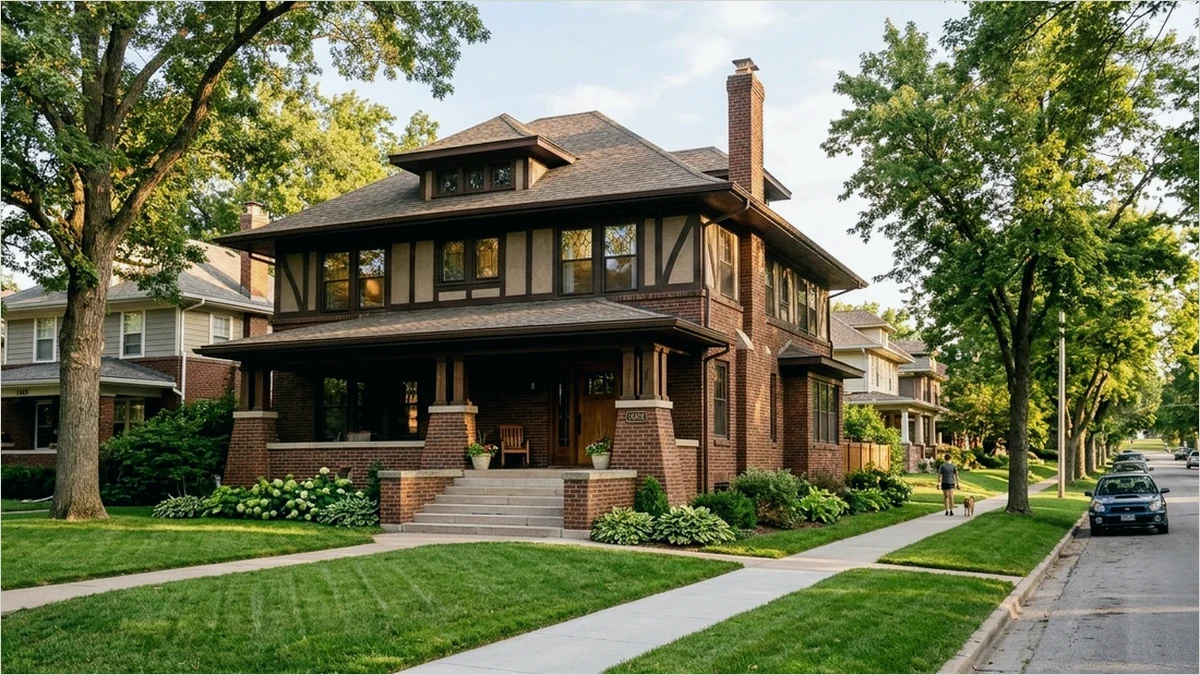
- Quarter-sawn white oak displays distinctive medullary rays that disappear if aggressive drum or belt sanding thins the surface.
- Alligatoring amber shellac on 1915 woodwork often re-amalgamates with denatured alcohol rather than requiring chemical paint stripping.
- Custom knife grinding lets local millwork shops replicate historic casing, picture rail, and colonnade profiles to within 0.015 inches.
- Preserving original mortised hardware and wavy glass doors inside buffet built-ins protects both architectural authenticity and appraisal value.
Identifying Original Finishes Before Touching Historic Oak
Early twentieth-century Prairie and Craftsman interiors—such as those designed by architect F.A. Henninger in 1915 Omaha residences—rely on horizontal continuity of quarter-sawn white oak baseboards, plate rails, beamed ceilings, and dining room buffets. Across Urban Restorative evaluations since 2021, the single costliest interior mistake owners make is attacking darkened or cracked woodwork with 80-grit sandpaper. Aggressive sanding rounds crisp chamfered edges, blurs joinery lines, and exposes raw unaged timber that never blends seamlessly with adjoining rooms.
Before selecting any solvent, test an inconspicuous baseboard return with denatured alcohol and mineral spirits. If the finish softens and becomes tacky under a cotton swab soaked in denatured alcohol, the original coating is amber or garnet shellac. Because shellac dissolves in its own alcohol solvent, crazed or alligatored surfaces can frequently be re-amalgamated by padding fresh dewaxed shellac and alcohol across the wood, preserving the deep 100-year patina underneath.
Replicating Missing Profiles and Built-In Joinery
When prior renovations removed a section of baseboard, pocket door casing, or colonnade bookcase trim, off-the-shelf big-box moldings will immediately look undersized and flat. Historic trim profiles used fuller dimensional lumber—often a true 7/8-inch thickness rather than modern 9/16-inch stock—and deeper cove or ogee relief cuts. Removing a 6-inch sample of intact casing allows a custom millwork shop to grind high-speed steel shaper knives matched exactly to the original profile.
| Millwork Element | Typical 1915 Dimension | Primary Wood Species | Preferred Restoration Method |
|---|---|---|---|
| Three-piece baseboard & cap | 9.5 to 11.5 in. total height | Quarter-sawn white oak | Alcohol re-amalgamation; custom knife cap splice |
| Door & window casing | 4.5 to 5.5 in. wide, 7/8 in. thick | Quarter-sawn oak or yellow pine | Low-heat or citrus strip only if latex-painted |
| Picture & plate rail | 1.75 to 3.5 in. profile | Quarter-sawn white oak | Re-anchor into plaster lath with trim-head screws |
| Dining buffet & colonnade | Full-wall built-in assembly | White oak with leaded glass | Re-putty leaded caming; polish brass latches |
Safe Stripping Protocols for Overpainted Woodwork
Where mid-century owners painted over quarter-sawn oak casings with multiple coats of alkyd or latex paint, restoration requires patience and containment. Alkaline caustic strippers should be avoided on white oak because high-pH chemicals react with natural tannic acid in the wood, turning the timber black and raising grain fibers severely. Instead, neutral-pH soy or benzyl-alcohol gel strippers combined with brass-bristle detail brushes lift paint from tight beads and plinth blocks without darkening tannins.
- Lead-safe containment: Seal doorways with 6-mil poly sheeting and use HEPA vacuum extraction whenever disturbing pre-1978 painted trim.
- Grain-direction scraping: Pull carbide profile scrapers strictly parallel to the oak grain to prevent cross-grain tear-out.
- Tannin neutralization: If dark water stains appear near window stools, apply a mild oxalic acid wash and rinse thoroughly with distilled water.
- Topcoat selection: Seal restored oak with dewaxed garnet shellac followed by hand-rubbed satin tung oil varnish or paste wax for repairable luster.
Balancing Modern HVAC With Historic Wood Stability
Interior millwork failures after restoration often trace back to sudden winter indoor humidity drops caused by oversized forced-air furnaces. When indoor relative humidity falls from 55 percent in August to 18 percent in January, wide oak panels shrink across the grain and split along glue joints. Integrating a whole-home bypass or steam humidifier tuned to hold 35 to 42 percent relative humidity during winter protects both restored quarter-sawn cabinetry and original strip oak flooring.
Patina in quarter-sawn oak is an unrepeatable record of time; a restoration should clean and feed the surface, never erase it.
Frequently Asked Questions
Why does quarter-sawn oak look different from plain-sawn oak?
Quarter-sawing cuts the log perpendicular to the growth rings, exposing tight vertical grain and shimmering medullary rays that resist cupping and warping.
Can I use polyurethane over original 1915 shellac?
Only after sealing with a thin coat of dewaxed shellac, because waxed shellac prevents oil or waterborne polyurethane from bonding cleanly.
How do you clean tarnished brass cabinet latches without ruining patina?
Wash gently with warm soapy water and a soft microfiber cloth, then buff with microcrystalline wax rather than abrasive metal polishes.
Related Preservation Notes
Historic Masonry, Mortar, and Foundation Preservation Hub
Updated for 2026, this Urban Restorative reference indexes 5 core structural assemblies used across 1915 Prairie and 1930 Tudor
Period Millwork, Plaster, and Interior Finishes Hub
Established in 2021, Urban Restorative catalogs 5 interior finish systems across Omaha Tudor Revival and Prairie residential
Lime Mortar Repointing Protocol for 1915 Historic Brickwork
In 2026 field audits, Urban Restorative confirms that Type O lime mortar prevents freeze-thaw spalling on 1915 Omaha clay brick